
To include your very own guide to Spanish Olives
Olives. People either love them or hate them. There rarely seems to be an in-between. Their salty, briny flavour either makes someone happy or immediately triggers that scrunched-up “absolutely not” face.
Personally, I love them. Well… most of them. There are definitely a few varieties I happily skip if they appear in front of me. And honestly, location matters. Olives are not created equal around the world. In the Mediterranean? Absolutely. In parts of the U.S.? I’ll pass. But in general, I find olives make almost everything better, whether it’s a cold beer, a glass of wine, or a simple afternoon snack.
Living here in southern Spain, olives are part of daily life. In fact, it would be hard to live in Andalucía and completely avoid them. Sit down at almost any bar or terraza, order a drink, and suddenly a small cazuela de barro (terracota plate) filled with olives magically appears at your table. No ceremony. No menu request. They just arrive, as they should.
And honestly, there is something almost perfect about salty olives and an ice-cold beer in the Spanish heat. It feels simple, local, and very Andalucía.
Olives are far more than just a snack here. For many families across southern Spain, history, culture, tradition, and livelihood are all wrapped into one tiny fruit. Which is why it always surprises me how many visitors don’t realise Spain is one of the olive capitals of the world.
A Little History
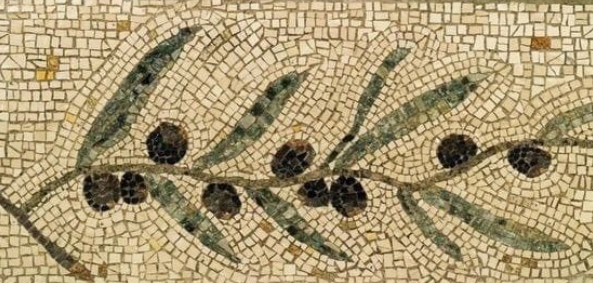
The relationship between Spain and olives goes back thousands of years, long before tapas bars and terrace beers entered the picture.
Most people credit the Greeks or Romans with spreading olive cultivation across the Mediterranean. Still, it was actually the Phoenicians who played a massive role in bringing olive trees and olive oil production westward.
Originating from the Levant region of the eastern Mediterranean, the Phoenicians were master sailors, merchants, and traders. Between roughly the 16th and 6th centuries BC, they travelled across the Mediterranean establishing trade routes, settlements, and agricultural hubs, including olive groves.
And olives were big business.
Olive oil was not just used for cooking. It was medicine, lamp fuel, cosmetics, religious offerings, and an important trade commodity. In many ways, olive oil was the liquid gold of the ancient Mediterranean world.
The Phoenicians established settlements throughout what is now southern Spain, including Cádiz (then Gadir) and Málaga (then Malaka). They also spread throughout North Africa, Sicily, and beyond, laying the foundation for the olive culture that still defines much of the Mediterranean today.
Later, the Carthaginians and eventually the Romans expanded these traditions even further. Under Roman rule, olive oil production exploded across Hispania, especially in Andalucía, where olive groves still dominate the landscape today.
A little historical note: the habit of being served olives alongside drinks isn’t actually new.
The ancient Romans frequently ate olives alongside their wine. Just like today’s Spanish tapas tradition, they understood that the salty, savoury nature of olives not only enhanced the flavour of wine but also stimulated the appetite.
In a way, not much has changed; you’re still sitting at a table, drinking wine or beer, and being handed olives without really asking for them.
From Ancient Groves to Modern Andalucía
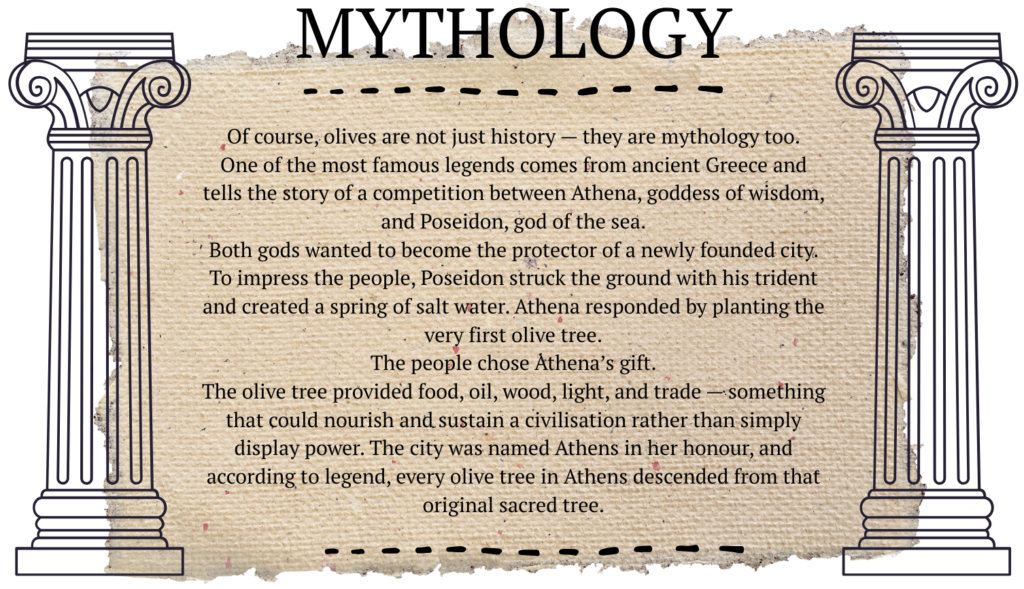
While the gods gave olives their symbolism, it’s the everyday reality of southern Spain that keeps that legacy alive.
Fast forward a few thousand years, and not much has changed. Andalucía is still obsessed with olives.
Southern Spain is home to one of the largest cultivated landscapes in the world: endless olive groves stretching across provinces like Jaén, Córdoba, Seville, and Granada. Drive through Andalucía and the landscape becomes an ocean of olive trees.
Andalucía is absolutely the jefe when it comes to olive oil production. In fact, the region produces more olive oil than Greece and Italy combined.
Spain also has around 260 olive varieties, each with different flavours, textures, and uses.
While Andalucía dominates production, other regions also play an important role:
- Castilla-La Mancha: Cornicabra olives
- Extremadura: growing olive production
- Catalonia: Arbequina, known for its smooth, mild flavour
Together, these regions shape Spain’s deep olive culture, one that is still completely woven into everyday life.
And before getting into the varieties, there is one thing that surprises almost everyone:
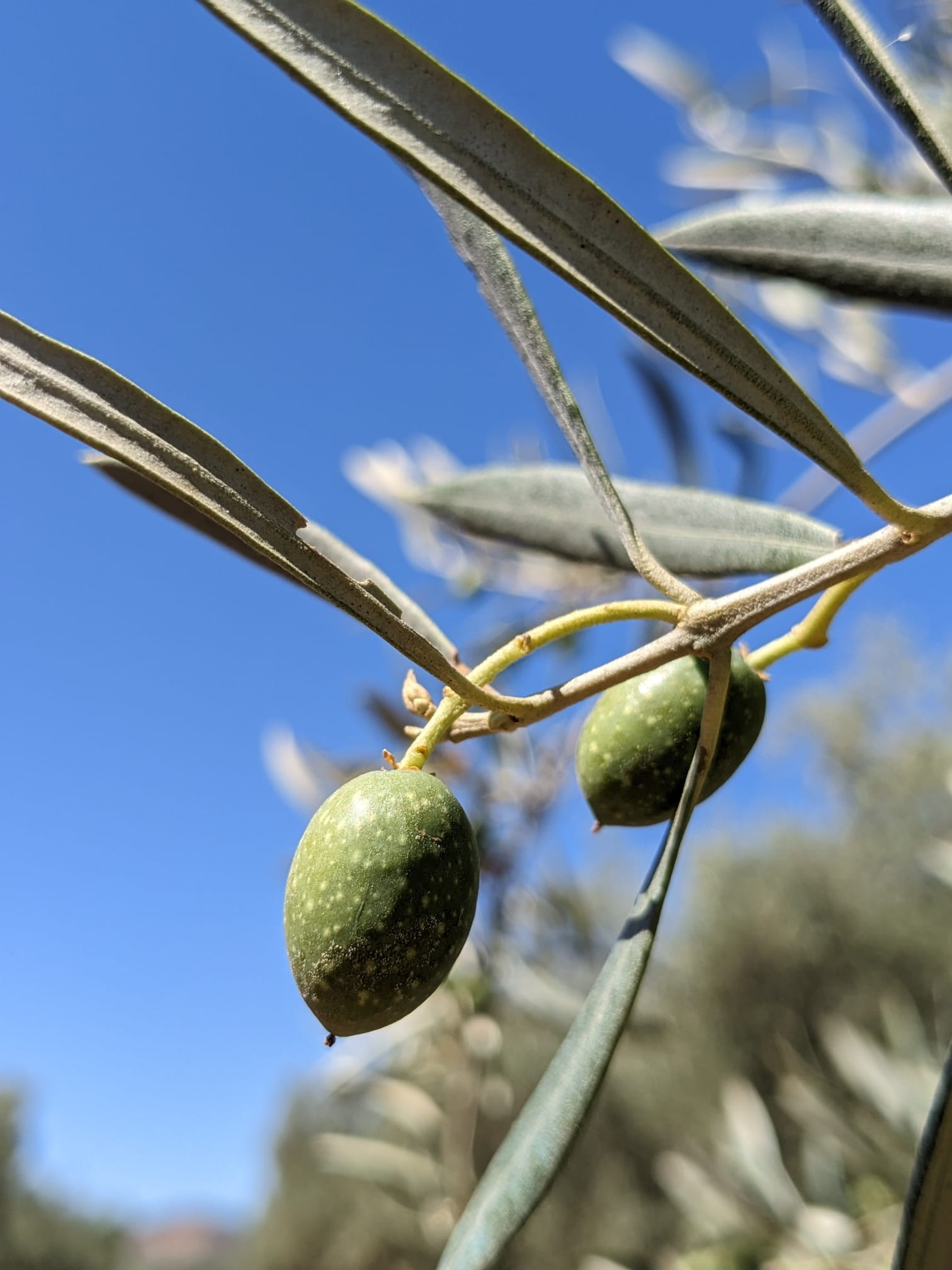
Green olives and black olives come from the same tree.
The difference is simply ripeness — green are picked earlier, black are left to mature longer.

The Fruit of Spain
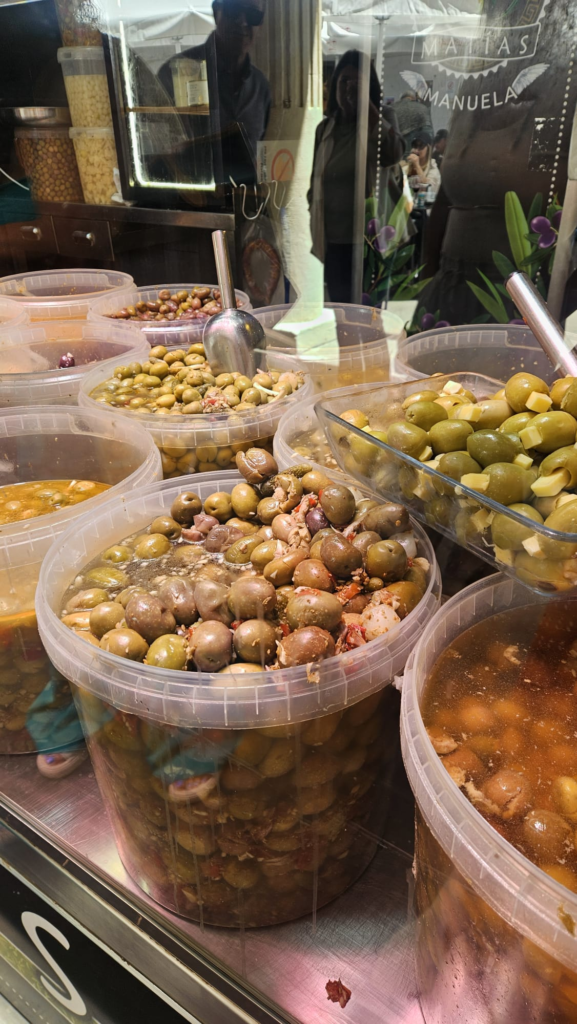
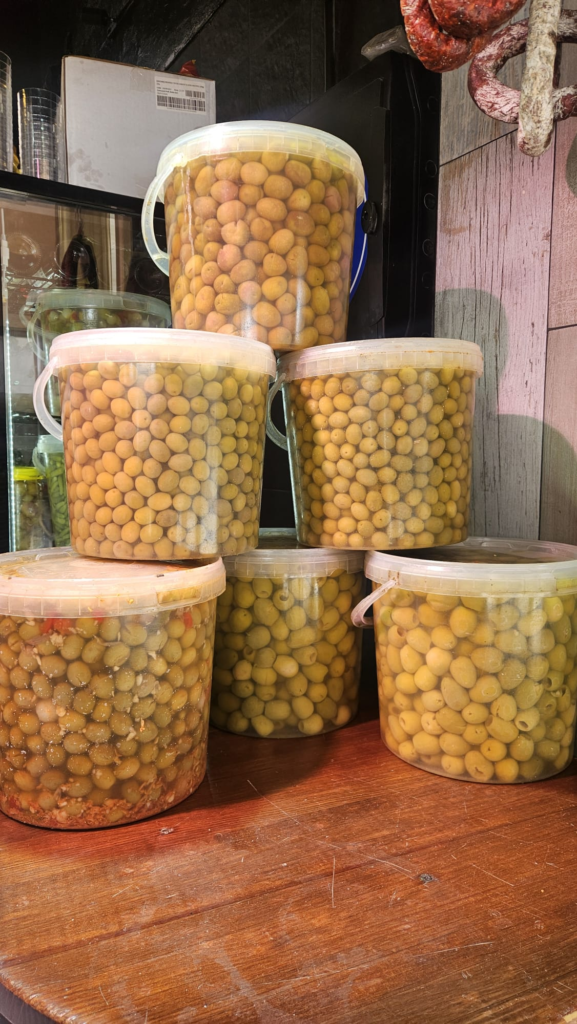
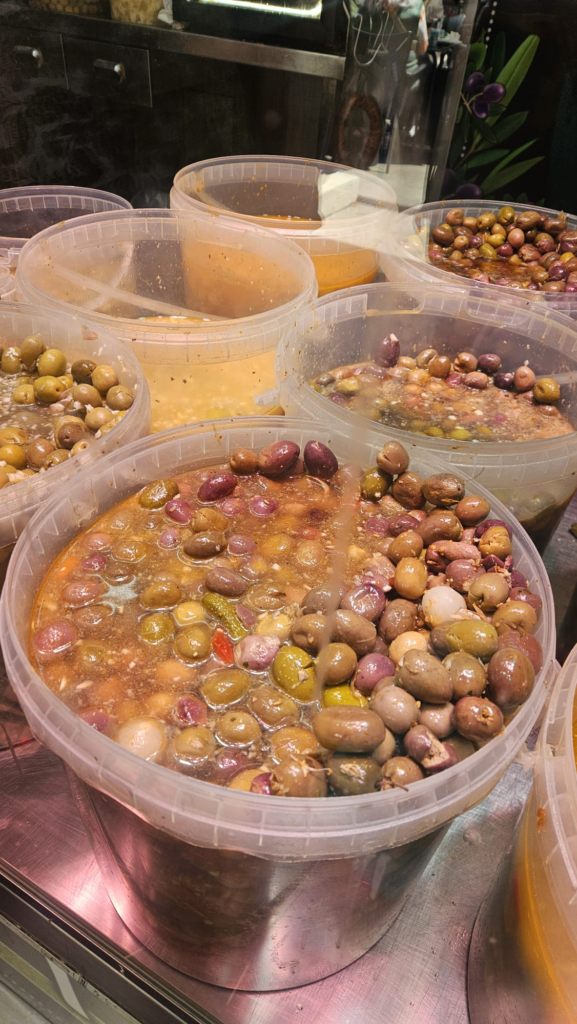
Walking through a Spanish market olive stall can feel slightly overwhelming the first time. Giant barrels overflow with olives in every shade of green, purple, and black, all soaking in different marinades of garlic, herbs, citrus, chilli, and olive oil.
Some are salty enough to wake the dead. Others are buttery, smoky, spicy, or almost sweet. And yes, locals usually already have a favourite olive vendor.
Although Spain produces hundreds of olive varieties, only a handful dominate Spanish gastronomy and olive oil culture.
Manzanilla Olives – or Seville Olives
These are the typical olives you get at a bar. Small, green, slightly firm,
- Taste: salty, slightly bitter, clean
- Where: everywhere (bars, markets, supermarkets)
- Best with: beer, sherry, doing absolutely nothing in the sun
- Seasoning (aliño): flavored with a classic aliño featuring garlic, orange peel, oregano, lemon, thyme, and a dash of olive oil to protect the olives from the air
These are a great olive to start with; Some of the most popular ones are Manzanilla olives with anchovy flavour
Gordal Olives – “Fat” Olive
Big and plump, the Gordal olive is highly prized for its large size. Also known as “Gordal Sevillana”, Bella de España, or Morcal de Limón.
- Taste: mild, juicy, not too salty
- Texture: soft and meaty
- Consumption: used exclusively as a table olive, since the oil content of the fruit is low.
These are the olives are often stuffed with peppers, garlic, almonds, or anchovies.
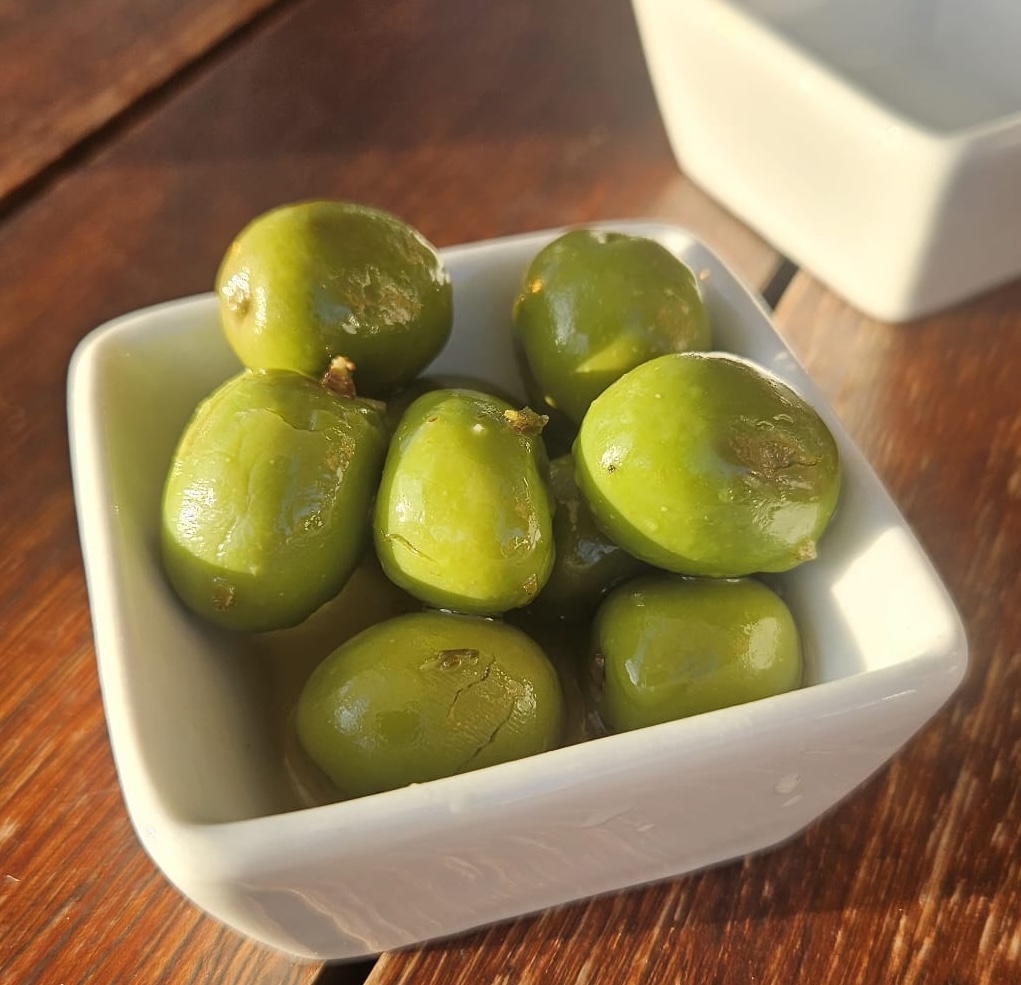
Aloreña – Crushed Olives or Malagueñas.
Cracked, marinated, and full of personality.
- Taste: garlicky, herbal, slightly tangy
- Texture: soft but not mushy
- Where: traditional markets and deli shops
- Seasoning (aliño): preserved in brine, and their seasoning includes thyme, garlic, red sweet peppers and fennel
These olives are smashed to break the olive’s tough skin and flesh. This way, the brine can soak into the skin quickly
Cuquillo / Regional Black Olives
Deep, earthy, it is considered a black olive, but the colour is often purpleish/brown and often local to specific regions like Aragón and parts of Catalonia.
- Taste: earthy, slightly sweet, less salty
- Texture: softer, sometimes wrinkled
- Best with: cheese, bread, wine
- Seasoning (aliño): thyme, water, and salt
These are the olives people either love… or completely ignore (like me).
Arbequina Olives
Slightly rounded and larger than many other olive varieties, these olives are considered one of the most balanced varietals and have a higher oil content than most. They have a deep green colour, thin supple skin, and a slightly wrinkled texture — but are dangerously easy to like.
- Taste: mild, fruity, almost buttery
- Texture: soft
- Origin: Catalonia
- Consumption: great for snacking and for its oil
They go down very smoothly — almost too smoothly.
Picual Olive
The king of Spanish olives. Especially dominant in Jaén, where olive groves stretch endlessly. They are inedible and must be debittered before becoming a table olive.
- Taste: bold, bitter, strong, and peppery
- Texture: firm
- Famous for: intense, stable olive oil
- Consumptions: frequently used as both table olives and olive oil.
- Seasoning (aliño): garlic, lemon, and rosemary
This is not a gentle olive. It has opinions.
Hojiblanca – “White Leaf”
Named for the pale underside of its leaves.
- Taste: grassy, nutty, slightly peppery
- Texture: firm and meaty
- Consumptions: frequently used as both table olives and olive oil.
- Best with: beer, vermouth, cheese, cured meats
A very Andalusian staple, many times allowed to mature to a black olive because it maintains its quality during the preparation process.
Chupadedos – “Finger-licking.” Olives
Mostly found in southern Spain, these olives are typically made using Hojiblanca olives, but the real star is the aliño. The intensely flavorful marinade that gives them their name.
Aliño: garlic, red pepper, oregano, cumin, vinegar, extra virgin olive oil, salt, and sometimes bay leaf or chilli for a spicy kick.
The olives are left to marinate for several days, allowing all the flavours to deeply soak into the fruit.
- Taste: bold, garlicky, tangy, slightly spicy
- Texture: firm and juicy
- Best for: people who cannot stop snacking once they start
The name literally means “finger-licking” — because once the olives are gone, people usually want to mop up every last drop of the marinade.
Check out your very own guide to Spanish Olives:
Other Notable Varieties
Cornicabra (Castilla-La Mancha)
Named for its horn-like shape, mainly used for high-quality olive oil.
Empeltre (Aragón)
Dark, smooth, slightly sweet olives are often used both as table olives and for mild olive oil.
Are Olives Actually Healthy?
For something so small, olives have built quite a reputation within the Mediterranean diet — and some would even say they are one of its defining foods, along with olive oil itself.
They are rich in healthy fats, antioxidants, and vitamin E, and have long been associated with heart health and anti-inflammatory benefits. Extra virgin olive oil, in particular, is one of the foundations of Mediterranean eating, which probably explains why Spanish grandmothers treat it somewhere between food and medicine.
Of course, olives can also be salty little beasts depending on how they are cured, so moderation does exist… technically.
But overall, they are one of those rare foods that feel indulgent while still being genuinely good for you.
And honestly, that feels very Mediterranean.
A Few Things to Know When Buying Olives at a Market
If you visit a traditional Spanish market or Mercado de Abastos in Andalucía, there are a few things worth knowing before stepping up to an olive stall. The stalls are typically labelled encurtidos (pickled goods) and aceitunas (olives). If you need a traditional shop, then a shop labeled variantes will be something you will want to search for.
Markets here don’t really operate like strict queues. It’s more of a social order. If you’re unsure, just ask:
“¿Quién es el último?” (Who is last?)
What to ask for: typically either by variant (such as the ones we talked about above) or by preparation: this means we are looking for Look for partidas (crushed), rellenas (stuffed, anchovies cheese, peppers), or aliñadas (marinated).
“Aliñadas” simply means marinated olives, and every bar, family, and market has their own version.
Typical Mediterranean ingredients:
- garlic
- herbs
- vinegar
- citrus peel
- rosemary
- sometimes chilli
No two aliñadas taste the same. This is where olive culture becomes personal.
Olives are usually sold by weight:
- ¼ kilo “un cuarto de kilo”
- ½ kilo “medio kilo”
- 1 kilo “un kilo”
Olives are typically sold in plastic containers or bags with brine (salmuera). Make sure there is enough liquid in the container to keep the olives properly preserved.
And don’t be surprised if you’re offered a taste before buying — that’s completely normal, you want to try them before you buy.
Above all, don’t rush it. Olive stalls are not fast food counters. They’re part shopping, part conversation, part ritual.
If you are looking for a great place to purchase some local olives, check out the Matias stall and the Cádiz market.
Final Thoughts
Olives in Spain are more than just a tapa or bar snack. They are history, agriculture, tradition, family recipes, and daily life all wrapped into one tiny fruit.
And honestly, once you start eating olives in Andalucía, it becomes very difficult to go back to the sad canned versions sitting in supermarket aisles elsewhere.
Whether you love them or remain suspicious of them, olives are one of the easiest ways to taste the history and culture of southern Spain.
And if a small bowl of olives magically appears next to your drink at a local bar… now you know it’s not just a snack — it’s a centuries-old habit still running on autopilot.
If you are interested in making your own olives at home, check out our blog, How Olives are Made




0 Comments